
Permission to film an interview does not, on its own, settle whether a producer can use AI to give the speaker a new line. In Canada, rights in the material, privacy obligations and agreements with participants answer different questions. In Quebec, the purpose of the processing and the destination of the files matter before an editor uploads a take. Start with what will change: whose voice the audience will hear, what the person agreed to say and who needs the recording to make the edit.
Three layers of rules for the same take
An interviewee gives an instruction on camera. In the edit suite, the director notices that a word could leave viewers unsure what to do. The editor could cut the ambiguous phrase, the producer could book a pickup, or the team could propose a replacement line that sounds like the interviewee. The change might take up little space on the timeline. For the speaker, though, there is a considerable difference between shortening an answer and appearing to say words they never recorded.
Federal law addresses several distinct interests: copyright in a work, appropriate purposes for handling personal information and, under the Criminal Code, the non-consensual distribution of intimate images. In Quebec, the Civil Code protects privacy, while private-sector privacy legislation governs what an enterprise does with personal information. A production agreement brings the question down to a particular take. What did the parties agree the production could do with it, and for which deliverable?
| Text or agreement | What it addresses | Question for an AI-assisted video |
|---|---|---|
| Copyright Act | Ownership, assignments and moral rights | What rights does the production have in the script, music and footage supplied to the editor? |
| Civil Code of Québec | Privacy and reputation | How will the commercial cut use the participant's voice or likeness? |
| Quebec's private-sector privacy Act | Purposes, consent and disclosure | What personal information will leave the edit suite, including on tracks the audience never hears? |
| Quebec's information technology Act | Biometric identity verification and biometric databases | Is the team recording a face or using its characteristics to confirm identity? |
| Federal private-sector privacy legislation (PIPEDA) | Appropriate purposes for handling personal information | Can the producer justify this use in the circumstances of the shoot? |
| Criminal Code, section 162.1 | Non-consensual distribution of intimate images | The definition includes certain visual representations made with AI software. |
| Production or participation agreement | Agreed uses of the performance or deliverable | Does the agreement address a replacement line, an adaptation or a different release? |
In the estimate, describe the operation beside the deliverable rather than putting everything under “AI.” The director can explain what is unclear about the instruction. The editor can identify the source material needed for each possible fix. The producer can check the agreement against the proposed use. Our guide to AI and video in Canada places those choices in the wider production process. Knowing that a correction is technically possible does not tell the producer whether it was authorized.
Copyright: trace the inputs before promising the output
Who owns a work generated with AI remains a subject of discussion in Canadian copyright policy. Innovation, Science and Economic Development Canada (ISED) consulted on authorship and ownership, text and data mining, infringement and liability. Its report records what participants told the department. It does not decide who owns a particular video or establish a registration policy for everything an AI system produces. A delivery schedule that promises ownership should not rely on the consultation as proof that the production can make that promise.
Start instead with material the team can identify. Who wrote the instruction the interviewee was asked to explain? Who supplied the guide track? Was a reference shot provided for viewing during a discussion or for inclusion in the cut? Consider the proposed processing as well as the finished sequence. Saying that a reference image will never appear on screen does not answer whether the team may send it to a service. Mark separately what can be edited, what can be transferred and what still needs clarification.
Subject to the other provisions of the Copyright Act, the author generally starts as the owner of copyright. For a work made in the course of employment, the employer generally owns copyright first unless an agreement provides otherwise. A paid invoice is therefore a poor place to look for the scope of a transfer. For an assignment, find the document signed by the rights holder and read what it actually assigns. If production relies on a licence, check the use it covers rather than treating delivery of the file as permission for any use.
Moral rights are a separate consideration. They concern the integrity of the work and the author's interest in being identified as its creator or remaining anonymous. An author can waive moral rights in whole or in part but cannot assign them. Assigning copyright does not, by itself, waive moral rights. The guide to copyright, image rights and music in Canadian video production sets out the distinctions for the underlying material, quite apart from any question about an AI-assisted result.
Keep a short account of the creative decisions behind the export. Identify the rewritten passage, the selected take, the sound edit and any synthesized line that made it into the mix. This gives the editor a way to reconstruct a correction; it does not establish title. Be equally precise about working files. Delivering an approved line of dialogue is quite different from supplying source material that could be used to produce further lines in the same voice.
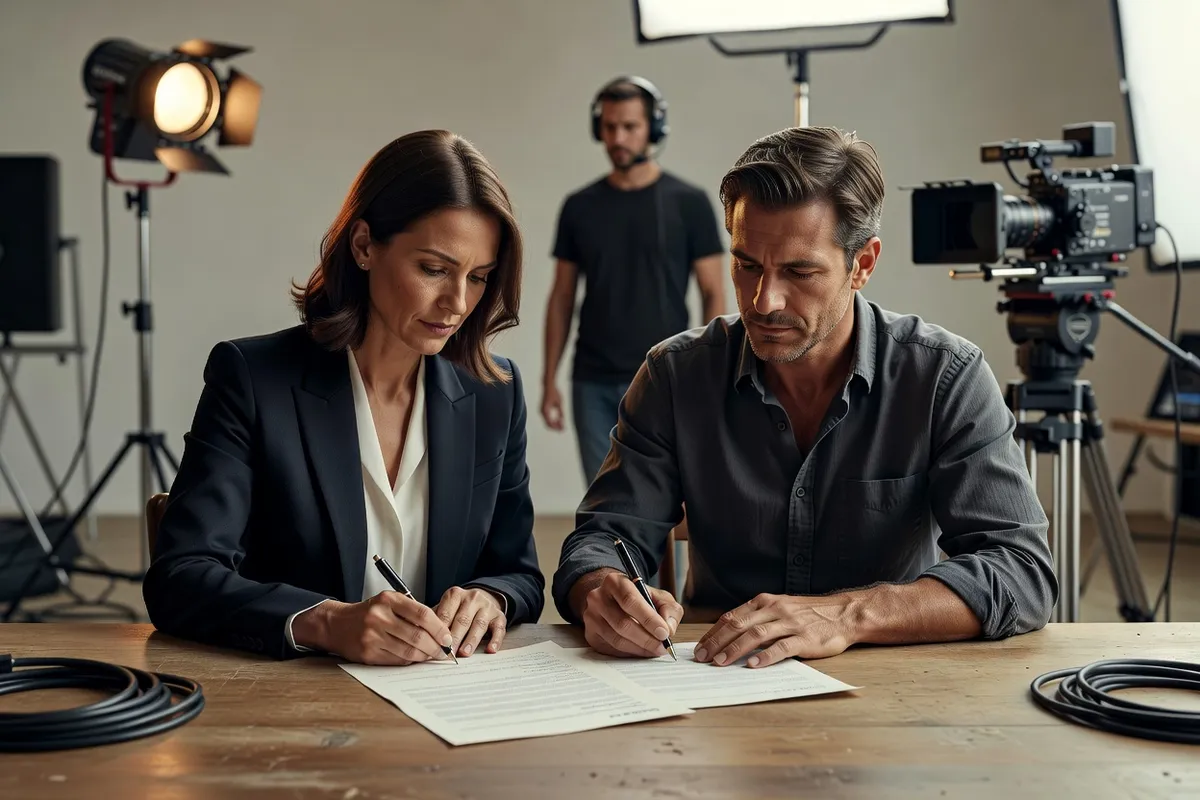
That distinction belongs in the estimate, not just in the archive notes. A request for “all audio” could mean the final mix without music, the isolated approved dialogue or every interview take. Ask which file the recipient needs and for what task. It is easier to agree on a usable deliverable when the description names its contents rather than leaving both parties to infer them at handoff.
Deepfakes and the Criminal Code definition of an intimate image
Section 162.1 of the Criminal Code addresses, among other things, knowingly publishing or distributing an intimate image while knowing that the person did not consent or being reckless about whether they consented. Under the amendment shown for 2026, the definition of an intimate image is not confined to a visual recording. It also includes certain visual representations produced by mechanical or electronic means, including AI software.
Paragraph 162.1(2)(b) concerns a representation depicting an identifiable person as nude or nearly nude, with sexual organs exposed, or taking part in explicit sexual activity. The representation must be likely to be mistaken for a visual recording of that person. The general term deepfake does not convey those distinctions.
Quebec's Law 25: what is the team doing with the face or voice?
Articles 35 and 36 of the Civil Code of Québec protect reputation and privacy. Article 36 identifies using someone's name, image, likeness or voice for a purpose other than legitimately informing the public as a possible invasion of privacy. For a commercial video, documenting consent to the intended use is prudent. Cutting away from the interviewee's face does not resolve the question if the point of the sequence is that viewers recognize who is speaking.
Quebec's private-sector privacy Act, amended by Law 25, calls for consent that is clear, freely given, informed and tied to a specific purpose. Ask about each purpose in plain language. Consent concerning sensitive personal information must be express. Rather than asking for permission to “improve the content,” play the original answer and show the proposed wording. Explain whether the team wants another performance from the interviewee or intends to reproduce their voice. The person can then decide whether to agree to the words, the method and the proposed use.
Biometrics raises a narrower question. Is the production using physical or behavioural characteristics to verify identity? Quebec's Commission d'accès à l'information (CAI) identifies facial recognition and voice characteristics in its guidance on biometrics. Those biometric characteristics are personal information. Recording someone answering an interview question is not the same operation as requiring them to confirm their identity through voice recognition. Equally, the fact that the team calls a recording “dialogue” tells you little about what a service will do with it.
Section 44 of Quebec's Act to establish a legal framework for information technology requires prior disclosure to the CAI and the person's express consent when biometric identity verification is required. Only the characteristics necessary for the purpose may be used, and they must be destroyed once it has been achieved. Creating a database of biometric characteristics or measurements must be disclosed to the CAI at least 60 days before it goes into service. That lead time concerns the database; it is not a waiting period for an ordinary interview shoot.
Ask the person proposing the workflow to describe the function, not just name it. Are they searching for a line, confirming who is speaking or keeping characteristics for later comparison? If the answer is unclear, leave the takes out of the service until the team understands the operation. Sections 90.12 and 91 of Quebec's private-sector privacy Act provide for administrative monetary penalties and penal fines; the calculation can take worldwide turnover into account. A release permitting publication does not dispense with obligations concerning processing.
Outside Quebec: follow the recording before sending it
Since September 2023, a Quebec organization must carry out a privacy impact assessment before disclosing personal information outside Quebec. The CAI explains that the disclosure may proceed if the assessment shows that the information will receive adequate protection. The relevant boundary is Quebec's, not Canada's. For the editor, the decision point is the proposed transfer of the source file, even if the public cut is still weeks of creative work away.
Consider what leaves the suite if the editor sends an entire interview to a service hosted elsewhere for a short audio correction. The file may include the interviewer's questions, the interviewee's discarded answers and remarks that nobody intended to publish. A transcript deserves attention too if it identifies a person. Looking only at the replacement line understates the proposed disclosure: a short result can come from a much longer recording containing information about more than the featured speaker.
Map the route in terms the editor can check. Where are the takes now? Who would receive a copy, and from where could it be accessed? Is the excerpt intended solely for the correction, or is some further use contemplated? What happens to the working copy after delivery? If the destination is unknown, say so. The location of the production manager who ordered the work does not establish the location of the processing. This account of the transfer helps prepare the assessment; it is not itself the assessment.

A pending assessment need not hold up a discussion about pacing. Put a temporary reading on the timeline that does not imitate the interviewee, identify it as a guide and leave space for the approved line. The director can hear whether the explanation fits the cut without anyone having to send the interview for processing first. Our interview with an editor on AI-assisted editing looks at such choices from the edit suite.
PIPEDA asks whether the purpose is appropriate, not just whether someone agreed
Under subsection 5(3) of the Personal Information Protection and Electronic Documents Act (PIPEDA), an organization may handle personal information only for purposes a reasonable person would find appropriate in the circumstances. That test applies to collection, use and disclosure. The Office of the Privacy Commissioner of Canada also explains that the person's knowledge and consent are generally required, except where seeking them would be inappropriate. “Did the person agree?” and “What justifies this use here?” are different questions.
Clarifying an instruction for the intended audience is a purpose the producer can explain. Building a supply of recognizable voices for projects nobody has yet described is another purpose altogether. Compare what each proposed edit contributes with what it asks of the interviewee. A pickup would give the speaker a chance to deliver the corrected wording. A clean cut or an explanatory title might clarify the instruction without imitating anyone. Choose on the merits of the actual problem rather than starting from a preference for a particular process.
In 2023, Canada's federal, provincial and territorial privacy authorities issued principles for generative AI that emphasize necessity, proportionality, transparency and accountability. Put those ideas to work on a concrete edit decision: why keep the full interview beside an approved dialogue track? If the recording is still needed, identify the remaining task and who needs access to perform it. “For future productions” tells neither the editor nor the speaker which use is proposed or why retaining the recording is necessary.
Ottawa: a historical bill, a transparency consultation and industry positions
Parliament's record for Bill C-27 concerns a previous session. The bill included a proposed Artificial Intelligence and Data Act and was referred to a House of Commons committee on April 24, 2023. It did not reach report stage, third reading or the Senate. No federal AI act resulted from that bill. A proposal in its text should not appear on a production release as though it were an obligation enacted by Parliament.
The federal consultation on AI transparency ran from July 23 to September 23, 2026. Among its subjects were detecting AI-generated material and knowing when one is interacting with an AI system. As of November 26, 2026, the consultation page indicated that a report on the feedback would follow; it did not present a final framework. A team can choose to tell viewers that a line was recreated without suggesting that the consultation established a general labelling requirement.
Industry submissions have a different status again. In September 2026, ACTRA described unregulated generative AI as a serious challenge for performers and Canada's screen industry. The Writers Guild of Canada also submitted comments that September, having raised concerns about the implications for creators in 2023. In its November 2025 submission, the Directors Guild of Canada called for author consent, credit and compensation, as well as transparency and labelling measures. These are dated positions taken by the organizations, not statutory provisions.
When costing the work, distinguish those public positions from the agreement governing the production. A guild's call for labelling does not tell the producer what a particular agreement requires for a replacement performance. The Canadian production overview of generative AI provides context for the industry's interventions. For the estimate at hand, ask which provision covers the proposed work and which decisions are still outstanding before anyone commissions it.
A consent and transparency protocol from estimate to handoff
Write the editorial objective into the estimate before committing to a method. For example, the production needs to clarify an instruction; if the proposed fix involves reproducing the interviewee's voice, the team will take that proposal to the interviewee. This leaves room for a recorded pickup and avoids promising a synthesized performance the person has not considered. It also gives the editor a clear task while the choice of method is pending.
Prepare a short decision sheet the producer and speaker can use during playback. It should preserve distinctions that a single box marked “AI use” would hide:
- Source: Identify the take and track precisely enough for the editor to find the approved material.
- Proposed change: Write out the replacement line. Say whether viewers would hear the original recording, a new performance or a reproduction of the speaker's voice.
- Processing: Describe which material would be sent to whom and why. Distinguish a test from the public deliverable.
- Release: Identify the version, context and intended audience. Keep another campaign out of the request unless it is actually under discussion.
- Follow-up: Record who will receive the response, who will check playback and where the person can direct a correction or consent withdrawal request.
At collection, Quebec's private-sector privacy Act requires information about the purposes and means of collection, access and rectification rights, and the right to withdraw consent. Give the explanation while it can still inform a choice. If the speaker agrees to the interview but declines voice reproduction, translate that answer into an edit instruction: retain the recorded answer; do not synthesize a replacement in this voice. Attach the instruction to the relevant take rather than expecting the editor to infer it from a filed release.
At final playback, check the exported dialogue against the approved audio. Listen to the cut in context as well: a line approved as a technical explanation can sound like a personal endorsement after a different preceding shot. If the team agreed to disclose how the voice was made, inspect the version the audience will actually see. A shortened excerpt may have lost the explanation that accompanied the longer cut.
At handoff, separate approved deliverables from temporary tracks and review what still needs to be kept. Once the purposes have been fulfilled, Quebec law provides for destruction of personal information or anonymization for serious and legitimate purposes, subject to a retention period prescribed by law. Do not deliver a supply of reusable voices simply because copying the whole edit folder is convenient. Name the authorized track on the delivery sheet and specify which working recordings are not included.