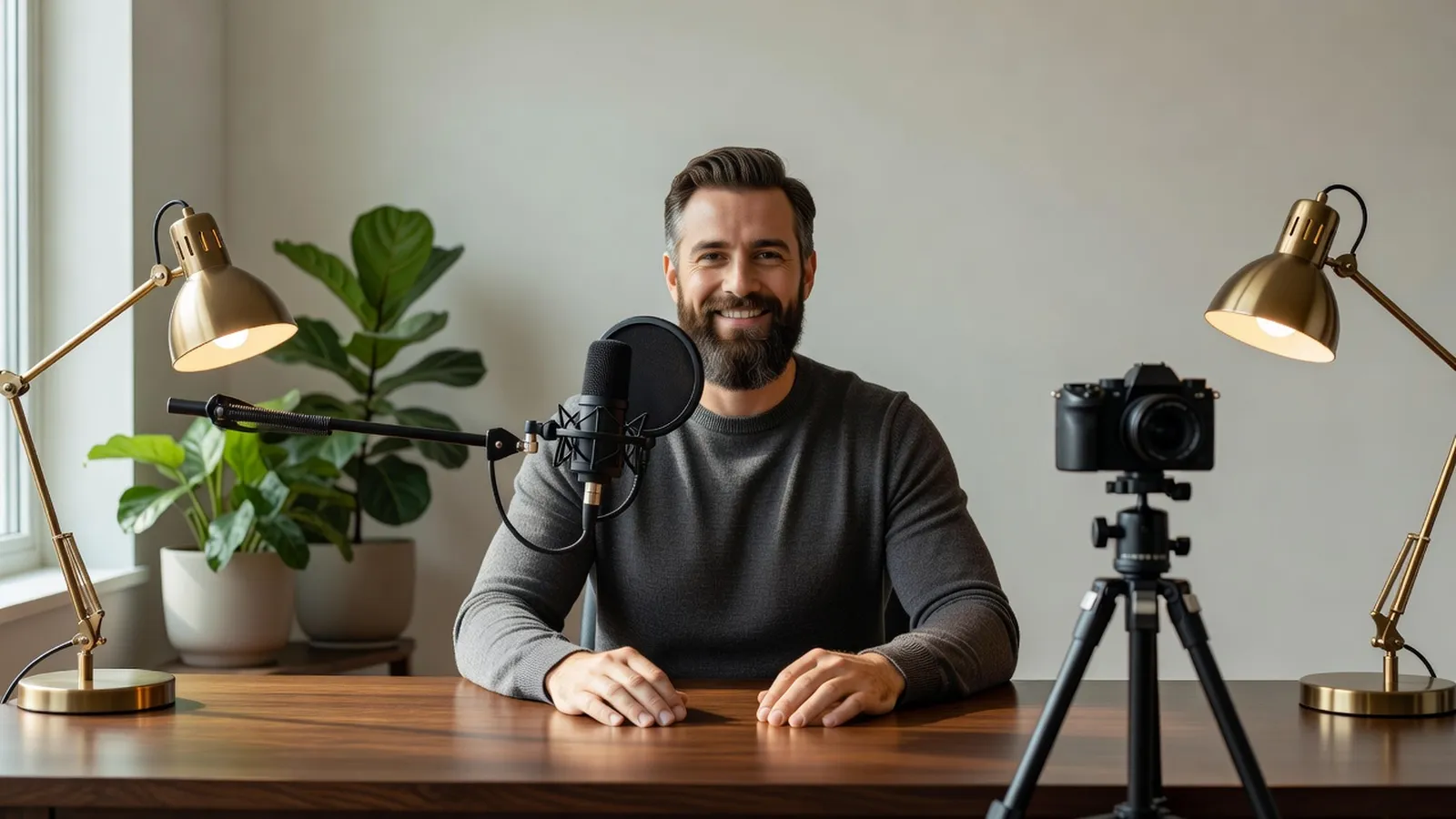
Alexandre Morin, a video content creator in Ottawa, is a fictional expert created for this guide: he does not exist, but his answers rest on official pages consulted on November 26, 2026. He explains how he reads the recommendations of YouTube, TikTok and Instagram, how he builds a calendar that does not depend on a single algorithm, and what the Canada Media Fund and the Online Streaming Act change for his work.
What platforms say about their recommendations
When people ask for "the secret of the algorithm", what do you tell them?
That there is no secret, and that what circulates under that name is almost always a guess presented as a rule. When I started out, I spent evenings reading forum threads where everyone swore they had found the ideal length or the perfect posting time. I never checked any of it. Today I work from a simple principle: I keep only what a platform writes itself, on its own explanation pages, and I note the date of the page. The rest I treat as workshop folklore, sometimes entertaining, rarely useful for planning a shoot.
They describe families of signals, not recipes. For YouTube, the "How YouTube Works" page explains that the recommendation system considers viewing behaviour, likes, dislikes, subscriptions and feedback, including satisfaction surveys. It adds that a channel's reputation and quality are considered, and that the platform uses external evaluators. What I take from that is that nobody can pull a single lever. You do not "do" satisfaction with a thumbnail: you earn it with a video that keeps its promise.
The same reading applies to the other two platforms I use. In each case I read the page, draw one or two editorial decisions from it, and go no further than the text allows. When a page says nothing on a subject, I remind myself that I simply do not know, and I do not fill the gap with a hunch.
YouTube: home page, Up Next and viewing behaviour
Where are your videos recommended, and what does that change about how you prepare them?
According to the official page, recommendations appear mainly in two places: the homepage and the Up Next panel. Those are two very different settings. On the homepage, a video meets someone who has asked for nothing in particular, so the title and thumbnail must give a reason to stop. In Up Next, the viewer has just finished a video and is still in the same frame of mind: a neighbouring topic, a consistent tone and an ending that opens onto what comes next count for more. So I prepare my endings as carefully as my openings, something I did very badly at the start.
Viewing behaviour is the first signal listed. How do you factor it into your edit?
I treat it as feedback on my editing, not as a verdict on my talent. When I look at retention statistics, I search for the exact spot where attention drops and go back to the edit: an introduction that runs too long, a passage that repeats what the previous shot already said, a transition that breaks the rhythm. I do not cut to "please the algorithm"; I cut because the audience has drifted away, and that behaviour is what the system observes. The nuance matters: I do not invent a length threshold to respect, because the page gives none.
That distinction also changes how I write a title. A title that promises a precise answer, which the video delivers in the first minutes, serves the viewer and the system that observes the viewer's behaviour. A title that exaggerates may win a click, but it produces a quick exit, and that exit is also viewing behaviour. I prefer a plainer title that says exactly what the viewer will find, even if it means giving up a catchier phrase.
One more detail from the same page: users can pause, edit or delete their search and watch history. In other words, the recommendations a person sees partly reflect what that person chose to keep. I cannot deduce from that what my audience sees, and I refuse to draw certainties about any one video.
TikTok and Instagram: each with its own signals and algorithm
How do you sum up what TikTok and Instagram publish about their recommendations?
With a table, because it is the most honest way to show what is known and what is not. Here is what I have in front of me, with the date of each page.
| Platform | What it publishes about its recommendations | Limit |
|---|---|---|
| YouTube | Viewing behaviour, likes, dislikes, subscriptions, feedback and satisfaction surveys; channel reputation and quality; external evaluators | No relative weight of signals, no length threshold |
| TikTok | Page dated June 18, 2020: user interactions, video information (captions, sounds, hashtags), device and account settings; neither follower count nor an account's previous high-performing videos are direct factors | A 2020 page: read it as a dated indication, not as the current state of the system |
| Page dated May 31, 2023: each part of the app (Feed, Stories, Explore, Reels, Search) has its own algorithm, tailored to how people use it. Help Centre: reels over 3 minutes are not recommended to new audiences | No ranking of signals; the 2023 page does not cover later changes |
This table is my safeguard. Whenever someone states a rule about one of these networks, I check whether it fits in one of these cells. If it does not, it stays a guess.
What on those pages made you change how you work?
Two things. First, the idea that Instagram has not one algorithm but several: content that works in the feed does not necessarily behave the same way in Reels or Explore. So for each video I decide where it should live, instead of posting the same thing everywhere and hoping it lands. For framing and formats, I point to our article on vertical video for Reels, TikTok and YouTube Shorts, which covers what I do not develop here.

Second, the three-minute limit for reels recommended to new audiences. It is not an obligation to go short: it is a condition for a reel to be offered to people who do not follow me yet. If I want discovery, I keep the short version as the entry point. If I want depth, I publish elsewhere, where length is not an issue. As for TikTok, the page notes that neither follower count nor an account's previous high-performing videos are direct factors. That reassures me on one point: a small account is not doomed in advance. It does not tell me, however, that any video will be distributed.
A calendar that does not depend on a single algorithm
How do you plan your publishing so you do not depend on one platform?
I think in three layers:
- long-form videos, which take the most preparation (research, script, a shoot over two or three sessions, a careful edit), are the slowest to produce and, for me, the most durable;
- short formats, cut from those videos or shot separately when the subject suits them;
- what I own: a contact list, a website, subscribers I can reach without going through a recommendation system.
That third layer grows slowly, but it does not switch off when a page changes.
My calendar is built backwards: I place the shoot days first, then the editing, and only then the publishing dates. A release should never be decided the night before, under pressure from a forum thread announcing an "algorithm change". Those announcements, when they do not come from the platform itself, teach me nothing verifiable.
I start with what the platform writes about its conditions. For YouTube, the Partner Program paths run through Shorts views, 3 million in 90 days for earlier access and 10 million for ad revenue sharing, or through long-form watch hours, 3,000 then 4,000 hours. Those figures come from YouTube's monetization page, which I reread before each decision, because they can change. I add one important point: the same page states that the total paid to creators, artists and media companies has grown every year for over a decade, as of December 31, 2025, but it publishes no typical income. So I cannot tell you what a creator earns, and I distrust anyone who does without a source.
For TikTok and Instagram, I found no official page I could read that gives monetization conditions, revenue shares or amounts. I do not cite any. The practical consequence is simple: I do not build my personal budget on a platform whose conditions I do not know. For the financial side of a production, including tax credits and funding programs, our article on tax credits and funding for a video production in Canada walks through the rules, with its own sources.
The Canada Media Fund and digital creation
Does the Canada Media Fund speak to creators like you?
It has a program aimed at that profile, the Digital Creators Pilot Program. According to the official page, it supports mid-career Canadian digital content creators making short-form video for YouTube, Instagram, TikTok and Facebook over a 12-month period. From 2026-2027, the program also opens to video podcasts on YouTube, Spotify and Apple Podcasts. What I find useful is that the program names the platforms where the work actually happens, instead of assuming a digital creator is necessarily producing for television.
I have to be careful, though, and I say so to everyone who asks: it is a selective program. Nothing I read allows me to promise that an application will be accepted, and no amount is published on the page I consulted. So I can neither tell you what to expect nor guarantee anything. Read the criteria on the official Canada Media Fund page and, if your situation is complicated, ask someone who knows these files.

As for the application dates, those for 2026-2027 have passed. The page indicates an opening on September 15, 2026 and a deadline of October 1, 2026, which was already past on the date this interview was prepared, November 26, 2026. I mention this because a creator who discovers the program today needs to know that applying for that period is no longer possible. What they can do is watch the official page and prepare what they will need next time: a clear portfolio, a 12-month content plan and an honest description of their progress. I do not know what the next dates will be, and nobody should announce them in the Fund's place.
The Online Streaming Act: what it changes for creators
Many creators worry about this law. What should they take from it?
First the context, as Canadian Heritage describes it: the Online Streaming Act received Royal Assent on April 27, 2023 and is the first major reform of the Broadcasting Act since 1991. The Canadian Heritage page I read was updated on August 20, 2025. I prefer to stay with the text.
That text adds section 4.1 to the Broadcasting Act. Subsection 4.1(1) provides that the Act does not apply to a program uploaded by a user to an online undertaking that provides a social media service. Subsection 4.1(2) adds a qualification: the Act does apply if the program is uploaded by the service provider, by its affiliate or agent, or if it is prescribed by regulation. For me, uploading my own videos, the first rule is the one that matters. The qualification only reminds me that the detail depends on the text and the regulations, which I do not claim to know in full.
Canadian Heritage also states that the government's policy directions to the CRTC include excluding the content of social media creators, including podcasts, from regulation. I rely on that page and on the text of the Act published by Justice Canada; I did not cite the CRTC itself, whose website could not be consulted to prepare this interview. If you have doubts about your situation, particularly if you upload content on behalf of a third party, this is a case where a lawyer's advice is worth more than my interpretation. The official explanations are gathered on the Canadian Heritage page on the Online Streaming Act.
What he would change if he started over
If you were starting from zero, what would you do differently?
I would begin by reading the official pages before watching a single tutorial. I lost months applying contradictory advice, when platforms publicly describe, at least in part, what they observe. Next, I would keep a decision log: for each video, what I changed, why, and what I saw. Without that log, you end up believing in causes that do not exist, because you have forgotten the three other things that changed the same week.
I would also document my planning mistakes. Several of my videos were shot too fast, on a subject I understood poorly, because the calendar demanded it. The result showed in the edit: cutaways to hide hesitations, a voice-over patching a vague point. A weaker video published on time never makes up, in my eyes, for a solid video published a week later.
I would also give myself a framework for progress. YouTube's Partner Program paths are benchmarks, not promises: reaching a threshold enriches nobody. I would rather ask whether my audience comes back, whether it comments, whether it contacts me. No recommendation system fully controls those signals, and they underpin everything I can build over the long term.
Finally, I would talk to other creators sooner. Our interview with a Quebec creator on making a living from a YouTube channel shows that a career is rarely built the same way from one person to the next. That diversity is reassuring: it is a reminder that there is no single path to copy.
For an overview of formats, platforms and the trade itself, the Social media video pillar gathers the articles in this series.
I would also stop measuring a video by its first day. The pages I read give no timeline for how recommendations evolve, so a single quiet day tells me little. I now wait, compare a video with my own earlier work rather than with other channels, and write down what I notice. It is slower, but it keeps me from rebuilding my whole plan around one disappointing upload.
Last, I would protect my own energy. A creator who burns out in the second year has no use for any recommendation system, however generous it might be. A calendar I can actually sustain matters more than any publishing trick I might have read about.
One last word, which applies to everything above: these remarks rest on public pages read on November 26, 2026. A platform page can change without notice, and the TikTok page cited above dates from 2020. Before making a decision that affects your income, reread the source, check its date, and keep only what it actually says.
The Plan Séquence editorial team