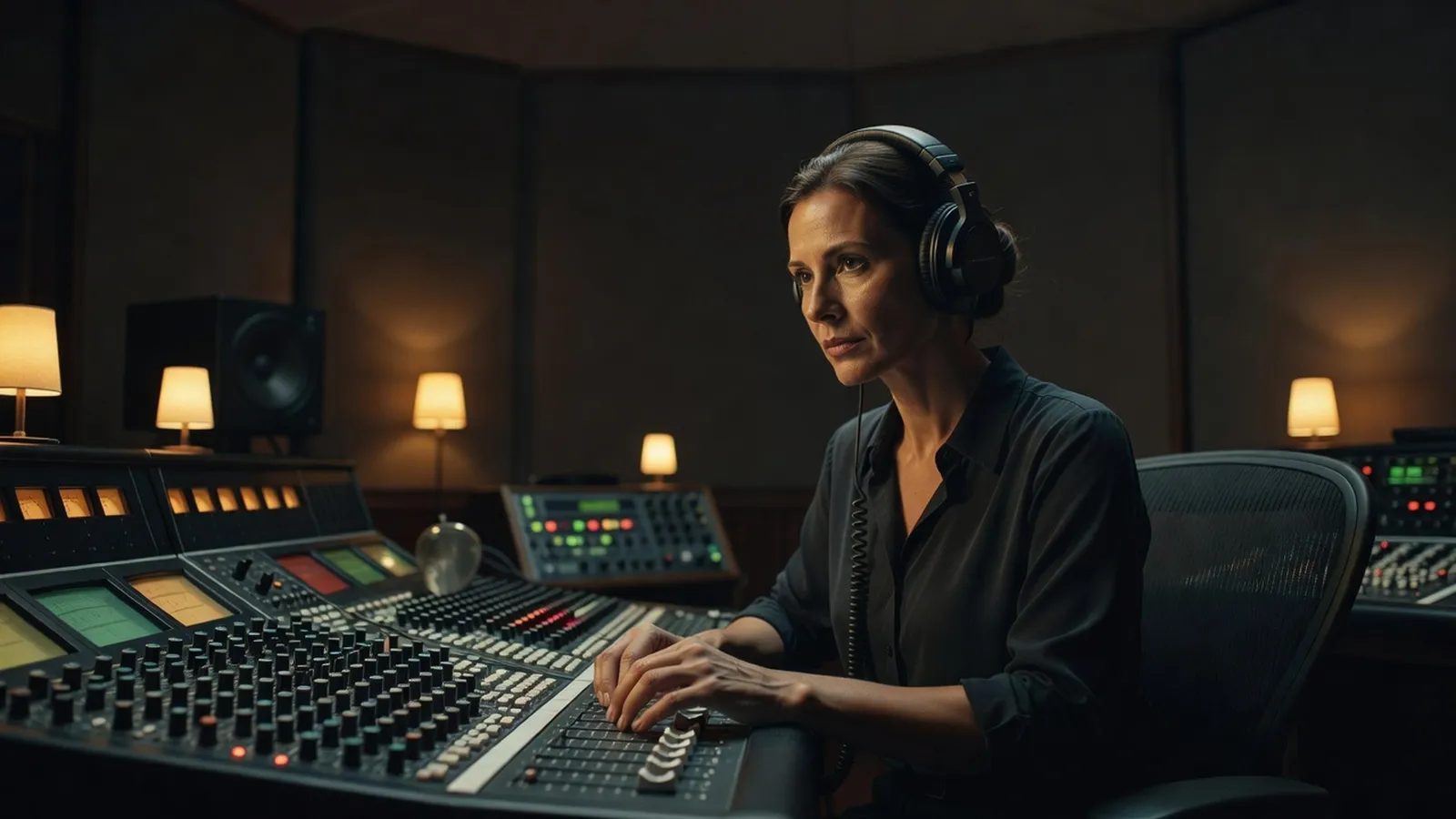
Dub, subtitle or hand a script to a synthetic voice: the choice turns on the audience's language, on the consent of the people whose voices are used and on how much room is left for directing performers. Nathalie Gauthier, a Montreal sound director and an expert imagined for this guide, explains how she decides in production, what Canadian rules say about the voice and why she always keeps a human ear at the end of the chain.
Bilingual dubbing seen from the recording booth
What does a bilingual dubbing session look like from the control room?
A session starts well before the performers arrive. I receive the edited reference version, the adapted script and a list of constraints: the length of each line, where the breaths fall, the intent of the scene. Adaptation is not a line-by-line translation. It looks for a sentence that fits in the character's mouth, at the right pace, without the viewer sensing the effort. In the control room I play the reference take, direct the performer while they work, then compare what comes out against the picture. The same line may be redone several times, because attention goes to the breath as much as to the word.
Bilingualism adds a difficulty of its own: French and English do not take the same time on screen. A concise sentence in one language can run longer in the other, and then you rewrite instead of speeding up. I learned to protect the pacing of the edit and to ask for cuts to the text rather than a rushed delivery.
What separates a successful dub from one that sounds false?
Synchronization matters, but it is not enough. A dub that sounds false is often one where each actor plays alone in a booth, without hearing the scene. When voices answer each other, the result comes closer to a real conversation. I also ask that the mix respect the original sound space: a voice that is too close and too clean detaches the character from the setting and gives the process away.
One last criterion that clients underestimate is consistency from one episode to the next. If a character's timbre shifts between sessions, the audience notices, even without being able to say why. So for each performer I note the distance to the microphone, the angle and the settings of the take, so I can find the same sound weeks later.
Finally, I look at register. A narrator for internal training does not speak like a character in a drama, and a Quebec audience does not hear the same turns of phrase as an audience in Western Canada. Bilingual dubbing is as much about choosing the right registers as about laying voices over images.
Synthetic voices: what they can do, what they cannot
What can synthetic voices do today, and where do they fall short?
I am speaking from studio experience, not about a particular tool: I name no product, because no official page gives me one to cite. A synthetic voice can read a text steadily, clearly and at any hour. For a working version, a narration mock-up or a timing check, it saves me time. I accept that use gladly, as long as everyone knows it is a mock-up.
Where it falls short is intent. A line delivered with a restrained smile, a hesitation, an anger that chokes: those nuances come from a performer's decision made in front of the scene. A synthetic voice follows a text; it does not play off a scene partner. I have no figure to give you on its performance, and I would rather not invent one. My criterion remains listening, take after take, with the project in front of me.
There is also a question of relationship with performers. An actor who learns that a synthetic voice was used to prepare a scene without anyone telling her loses trust, and that trust is a studio asset. I prefer to say things plainly at the first meeting: here is what we use, here is why, here is what we will not do.
Public policy is following these changes closely. Canadian Heritage states, on a page updated on 19 November 2026, that artificial intelligence is transforming how cultural content is created, produced and distributed, raising questions about the future of creative work, and that the government is working with creators, cultural organizations and industry to better understand these changes. That is a statement of context, with no rule or regulatory position, but it describes the mood well. For an overview of the whole file, the pillar page AI and video in Canada gathers this site's reference points.
A voice is personal information: consent and biometrics
Is a voice personal information?
I am not a lawyer, and I stick to what the official texts say. According to Quebec's Commission d'accès à l'information (CAI), behavioural biometrics analyses, among other things, a person's voice, gait or signature. Anyone who verifies or confirms a person's identity through a biometric process, or creates a bank of biometric characteristics, must disclose it to the Commission, at least 60 days before a bank is put into service. That page must be read for what it is: it deals with identification and authentication, and says nothing about voice synthesis as such. So I do not take it further than it goes.
The CAI also specifies that information is sensitive if it is medical, biometric or otherwise intimate, and that consent to sensitive information must be express. Express consent is already mandatory for biometric technologies used to verify identity. For production, the practical message is simple: a voice that is captured, analyzed or reproduced calls for caution, and caution starts with a clear agreement.
The Civil Code of Québec points the same way on privacy: every person has a right to the respect of their reputation and privacy, and no invasion of it may occur without consent or authorization by law (art. 35). Article 36, paragraph 5, lists among possible invasions the use of a person's name, image, likeness or voice for any purpose other than the legitimate information of the public.
What do you do in practice when a client asks to reproduce an actor's voice?
I start with three questions: whose voice is it, for what specific use, and for how long. Then I want written consent tied to that use. Under Quebec's private sector privacy act, as amended by Law 25, consent must be clear, free, informed and given for specific purposes; it is requested for each of those purposes, in simple and clear terms, and it must be express when the information is sensitive. A general "yes," signed once for every future project, does not fit that description.
I also point out that the Civil Code speaks of the use of the voice, not of cloning: I have read no decision that settles this particular case, and I will not claim otherwise. On 23 February 2026, the CAI announced that it had signed, with 61 privacy organizations worldwide, a joint statement on AI-generated imagery, published in response to concerns about systems that generate realistic images and videos of identifiable people without their knowledge or consent. I have read only the CAI's announcement, not the statement itself, and I treat it as a signal of context, not as a rule.
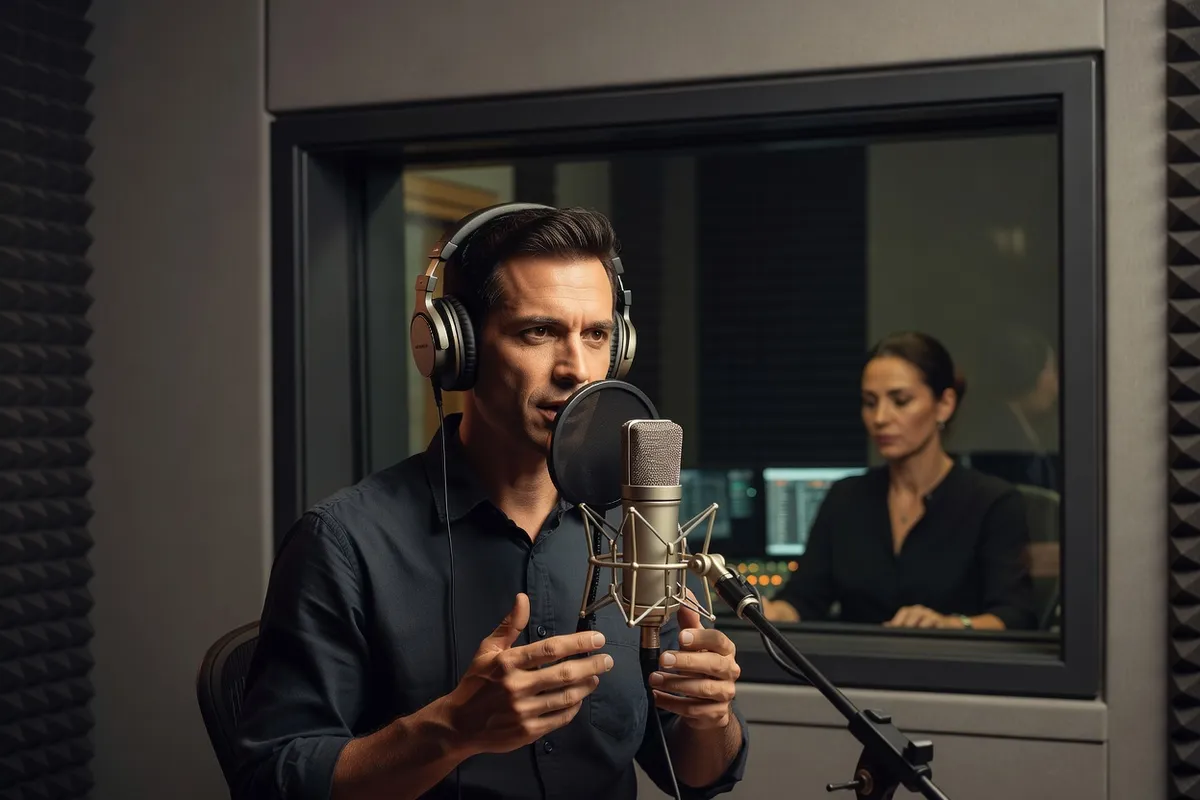
Dubbing or subtitling: a production decision
How do you decide between dubbing, subtitling or using a synthetic voice?
I start with the room, not the technology: who is watching, where, with what sound. Content viewed at a desk without speakers calls for captions. A drama or a long narration that has to be lived in the viewer's own language calls for a dub. A synthetic voice meets narrow, well-bounded needs. Here is how I compare the three, qualitatively, because I have no rates or technical standards to cite:
- Dubbing: performers' consent is negotiated and documented for each use; the language is worked by an adapter and a director; the relative lead time is the longest, with sessions and a mix; the main risk is an adaptation that drifts from the meaning or the rhythm.
- Subtitling: no new voice is captured, so there is little voice-consent exposure; the original language stays audible; the relative lead time is shorter, but proofing is demanding; the main risk is text that is out of sync or incomplete.
- Synthetic voice: the consent of the person whose voice served as the base must be established first, with the caution described above; the language depends on the supplied text and its review; the relative lead time can be short for a first version; the main risk is losing the intent and facing a complaint about the use of a voice.
If you choose captions, the Government of Canada's accessibility requirements are clear: videos with audio require synchronized captioning. Anything said or heard must be included, and captions must be synchronized with the audio, equivalent in content, including speaker identification and important sound effects, and readily available to those who need them. Those points come from the page on accessibility requirements for audio-video.
A good caption is therefore not simply text pasted under the picture: it accounts for part of the soundtrack. In practice I ask clients to decide early: once a dub is under way, going back to subtitles, or the reverse, means redoing the sound edit, the dialogue lists and sometimes the delivery structure. Better to lose half a day in preparation than weeks in rework.
When I prepare a captioned project, I build in proofing time, because a shift of a few frames shows immediately on screen. For short social formats, where captions, versions and accessibility are decided together, the article on posting in French and English on social media extends this discussion.
The language of audio-video content, in Quebec and elsewhere in Canada
How do you approach the language of content meant for the whole country?
I rely on a specific example that I read with its limits. The "Language of Audio/Video Content" page of the Government of Canada's digital accessibility toolkit says the first rule is to avoid bilingual videos. Captions must be in the spoken language and synchronized: English captions for an English speaker, and the reverse for French. The page gives the example of a bilingual event that was finally published as two videos, one French and one English. You can read it on the toolkit's own page.
I keep one important reservation: that page talks about government content subject to the Official Languages Act. I therefore do not present it as a rule for a private company. It remains useful as a point of good practice: publishing two versions rather than one video that flips between languages makes the content easier to follow, to caption and to distribute.
In Quebec as elsewhere, the audience question comes first. A Montreal client aiming at both a francophone audience and an anglophone audience in Ontario often does well to plan two complete versions from the script stage, instead of translating at the end. I encourage clients to discuss it with me at the writing stage, when language choices still cost little.
Directing performers, protecting the language
How do you direct performers, and how do you protect the language?
Directing starts with putting the performer at ease and giving them the scene: who is speaking to whom, what has just happened, what is about to happen. I give few notes at a time and leave one take free before refining. A voice that understands the intent often finds on its own the rhythm I would have tried to impose.
Protecting the language takes an ear and a glossary. I keep a list of terms to settle with the client at the start: product names, titles, turns of phrase the brand wants to keep. I watch for anglicisms that creep into a rushed adaptation, as for calques that let you hear the other language under the translation. Someone in charge of language review listens to the final mix, not just the script.
That vigilance is not a luxury. It is what separates a version that respects the audience from one that treats it as second-rate. I hold to that distinction, and I defend it in production meetings, when a tight schedule has to be weighed against a full review.
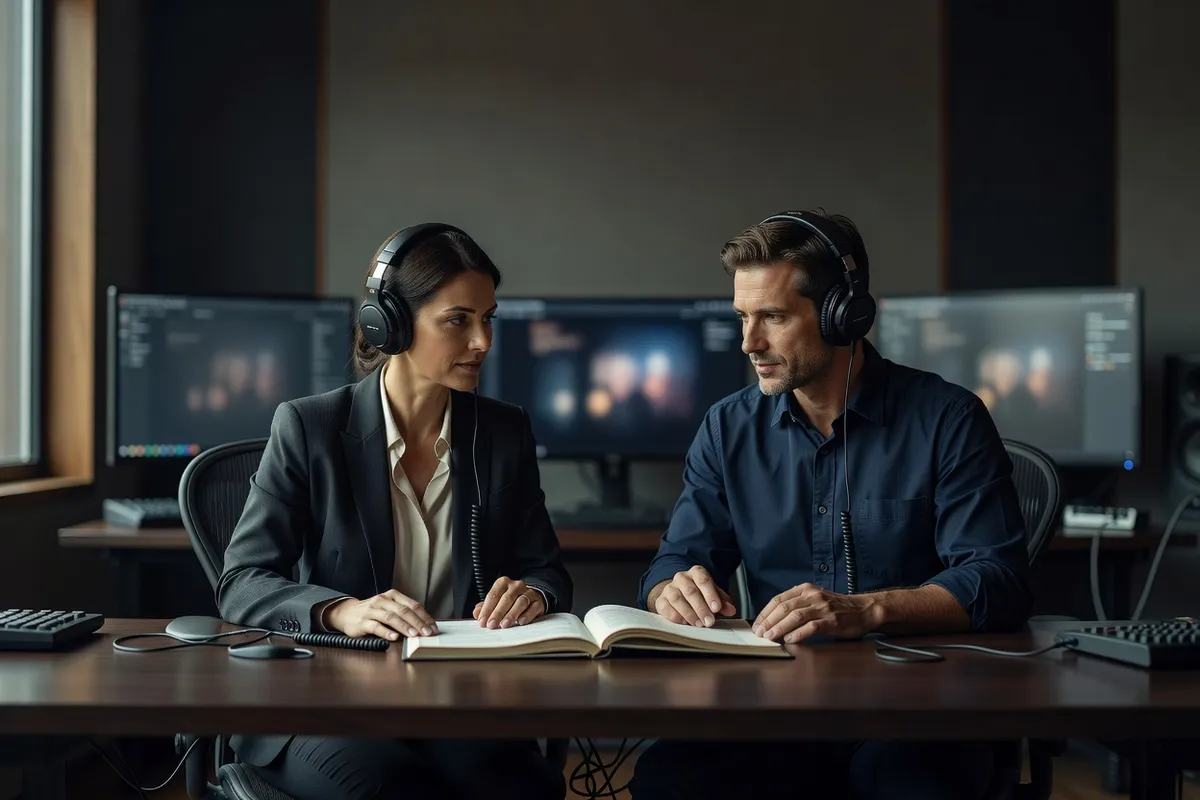
Showing a dubbed version: what Quebec's cinema act provides
What does the Cinema Act provide for a dubbed version?
Section 83 of the Cinema Act, in the version in force since 1 April 2017, governs the issuing of stamps for the public exhibition of a film in a version other than French. A stamp may be issued for every print with French subtitles. Otherwise, the act sets conditions tied to a French-dubbed version: a dubbing contract in Québec and a 45-day temporary stamp.
You need to keep the exact scope in mind. That section concerns the public exhibition of films. It does not concern the publication of online video, and I do not stretch it to a web video, a corporate video or social media content: I found no official source that says so, and I will not say it either. If a client asks whether a brand video is covered, I answer that I do not know and point them to a lawyer.
For a feature project, on the other hand, the question of dubbing and the stamp goes into the schedule from the start. A dubbing contract in Quebec, a temporary-stamp period, a subtitled print: each of these weighs on the release date. So I warn producers not to treat the dubbed version as an end-of-line formality.
Her working rules when a voice tool enters the studio
What working rules do you follow when a voice tool enters the studio?
I have five, which I repeat at the start of every project.
- Name the use: mock-up, working version or final version, and tell the whole team and the client.
- Obtain written consent, clear and tied to the use, for any reproduced voice, and keep it with the project files.
- Keep a human listening: a qualified person listens to the final version, for language and for intent.
- Never present a voice as human when it is not, where the audience could be misled.
- Treat training voices as personal information: restricted access, a defined retention period, deletion at the end of the project.
These rules rest on the principles published by Canada's privacy authorities for generative AI, which I reread as needed: necessity and proportionality, transparency, accountability. They come from my practice, not from an obligation I would claim to draw from a text.
The same questions arise in picture post-production. An editor's interview on AI-assisted editing gives another studio point of view.
To place the whole in the current framework, the article on generative AI and video production in Canada takes stock. For my part, I add one simple habit to these rules: I record every voice decision made during a project in writing, with the date and the person who approved it, so that no one has to reconstruct from memory what was agreed. My closing advice fits in one sentence: before installing a voice tool in a project, write down what you would do if the person whose voice served as the base withdrew their agreement tomorrow.